UZBEKISTAN – CITIES OF THE SILK ROAD
Recently highlighted by topical TV, Uzbekistan has just been rediscovered by the present generation of Westerners. One of only two doubly landlocked countries in the world, this central Asian state of 38 million people lies at the epicentre of the ancient trading routes linking China and Japan to Europe. This thoroughfare was once the only way for goods to be transported to and from the Far East, and trade routes from both East and West converged on the four main cities of Uzbekistan sandwiched between the arid deserts of the Asian Steppes and the impassable Tian Shan mountain range, rising to nearly 7,500 metres. In the thirteenth century, the Venetian Marco Polo trod this route and introduced silk and spices from Asia to Europe, along with examples of porcelain and paper money. These were exchanged for gold, glass and grapes, while other Europeans are credited with introducing dogs and horses to the Chinese.
Today the cities of Uzbekistan have expanded, initially under the patronage of the Russian Empire and more recently following the discovery of huge gas reserves which have fuelled their economy and propelled their progress into western consciousness once more. Toshkent, the capital with 4 million residents, has few remnants of its days as a silk road city as it was almost levelled by a huge earthquake in1966. Extravagantly rebuilt by Russia, it boasts a white marble theatre, the gigantic Hotel Uzbekistan with its fabulous ballroom (1) and a uniquely decorated metro line with each station a work of art in itself. Kosmonavtlar is dedicated to the first man and woman in Space, while Bodomzor mimics a palace, complete with gold guilt fittings. However, first prize, goes to Alisher Navoi which looks like the inside of a lavishly decorated mosque or church, complete with intricate cupolas in the ceilingand white marble pillars (2). Many soviet-era statues populate public places but are far from self-congratulatory relics from Russia. The most imposing tells the story of man’s fascination with flight, starting with Icarus and culminating in man’s first trip to space. Another is a fitting tribute to a couple who, while raising their own family, also brought up 15 other abandoned or orphaned children (3).
Toshkent, meaning city of stones, is a very relaxed town. Although almost everyone is Muslim, there is complete tolerance of a multitude of minorities and their faith and philosophy. Churches, Temples, Synagogues and Monasteries are tucked away in every corner, and the many historical influences on the city’s culture are represented in the sumptuous snacks served on every street corner. Italian ice-cream, Turkish kebabs, Georgian khachapuri, Indian curry and Chinese noodles jostle for attention alongside local dishes like dumplings and samsa (samosa with pumpkin). Tourists are still a relative novelty, especially fair-skinned blond girls as Karen soon discovered. Having happily been co-opted, she now features in a multitude of Uzbek family photographs!
Following the Silk Route, we took a sleek fast train to the fabled city of Samarkand (4). A quarter the size of the capital, it has retained many of its ancient buildings. The central Registan square is fabulous both day and night (5, 6) and is kept sparkling clean by a veritable army of workers constantly sweeping up leaf-fall and litter. The square is surrounded by mosques, mausoleums and madrasahs (Muslim schools of religious education). But prior to the arrival of the Arabs in the 8th century, most people followed Zoroastrianism. This is the oldest monotheistic religion and was founded in ancient Persia by the prophet Zoroaster who preached a philosophy centred on ‘good thoughts, good words, good deeds’. The Zoroastrian symbol is still embedded in many of the older buildings in town, representing the union between man and woman and the importance of the family unit. This philosophy remains an essential element of society in modern Uzbekistan, where older children are devoted to their younger siblings, and strangers are welcomed into the family circle. Families are large, averaging 5 children, and older people are prioritised and respected. As seniors are always supported by their extended family, retirement homes are unheard of. However, with an average male life expectancy of only 70, people are expected to marry young and stay together for life. Divorce is very actively discouraged, whilst homosexuality is not tolerated and is punished by prison.
The Stork is the national bird and symbolises peace, prosperity and the stability of family life. This societal stability is a relative novelty. In 1220, Genghis Khan invaded with his Mongolian army and conquered the whole of central Asia. His army looted and pillaged Samarkand after a month’s siege of its city walls. Its population was decimated but ironically the intermarriage with the invaders ultimately consolidated trade routes and relations. Two centuries later, Amir Timur (Tamerlane) ushered in an era of sweeping cultural renaissance and established his empire’s capital in the city. Under the subsequent Timurid dynasty, crafts flourished and Samarkand citizens became famous for their skill in working metals, wood and stone. Many unique musical instruments evolved during this period, along with other creative arts such as puppetry and poetry. The Uzbek language was considered too coarse for poetry, so this was initially written in Tajik which is closely related to Persian. By contrast, music was often accompanied by songs in Kazak. With camels for company, we camped in a yurt in the Kyzyl-Kum desert at night, listening to Kazak folk songs around an open fire under a star-spangled sky (7).
Moving on to the town of Bukhara through the endless Kyzyl-Kum, we were struck by the fields of red poppies and blue cornflowers which had appeared almost overnight after a damp day. Mulberry trees dominated the skyline and we learned of the essential part they play in local life. In addition to being the wood of choice for furniture, its tasty berries are full of vitamins and shared or sold as a treat. However, two traditional uses are unique to this tree. The smaller branches are harvested in Spring and stripped of both leaves and bark. The bark is ‘mashed’ in wooden tubs and then allowed to dry and concentrate into a thick mulch into which an A5-sized wooden frame is dipped. The water leaches out and the resulting material hung out to dry on a frame in the sun for two days. The resulting paper is resistant to both rot and rodents, and the parchment can last 500 years. It is the material on which generations of artisans have recorded their miniature paintings and poetic verses, allowing us a window into the past. Of almost equal import are the leaves stripped from the branches. These are the food on which silkworks thrive. In just one month a silkworm grows from the size of a pinhead to a caterpillar. It then spins silk into a cocoon from which it would later emerge as a butterfly, if it weren’t for the fact that their slumber is terminated prematurely by the harvesting of the silk. This is then woven on looms into fabrics for clothing or carpets, either as pure silk or mixed with cotton. The silk clothes have special names indicating their use: atlas is a long iridescent dress, while adras combines silk warp with cotton weft to allow the addition of sparkles and motifs toward off the ‘evil eye’. These deeply symbolic clothes are worn by women for 40 days both after marriage and childbirth.
Mulberry trees survive in the harsh hot summers when temperatures rise as high as 48C because their roots extend deep underground where they can access water. Water has become more problematic lately as a result not just of global warming, but of the monoculture of cotton encouraged by the Russians over several decades for financial reasons. Cotton is very water-consumptive and the rivers which fed the Aral Sea in the north of Uzbekistan were diverted to facilitate this. Water levels dropped dramatically, and as saline levels rose, thirty species of fish and many animals specific to the area became extinct. The situation was further exacerbated by the use of excessive amounts of chemicals as weedkiller or fertiliser which entered the water systems and has contributed to increased ill-health among the tribes still living near the remnants of the Sea. Attempts to reverse this trend have been made since the fall of the iron curtain in 1991 allowed Uzbekistan to declare independence, but it looks like it’s too late to reverse the loss of this unique habitat. However, elsewhere in the country horticulture thrives. The emerald-domed Chorsu market, the largest in central Asia, sells locally grown pistachios, walnuts, almonds, saffron, blueberries and 150 types of melon (8).
Buchara is small but perfectly formed (9). A town of 350,000 people, it is surrounded by ancient city walls and protected by a giant fortress. It is famous for its ancient buildings which include the 47-metres high 12 th -century Kalyan minaret (10). Genghis Khan is reputed to have lost his hat while looking up to the top of the tower, and was so awe-struck that he spared the minaret, along with most of the other ancient buildings in the city, from the destruction he wrought elsewhere! Buchara has always attracted artisans to its narrow winding streets, blue domed mosques and quiet canals. Carpets are still woven on traditional looms here, miniature paintings are hand-crafted on locally produced mulberry paper, and there is a fabulous puppet- makers. Named little Lilya after our guide, we brought one home (11).
Another national delight is the dish they call ‘Plov’. Made from rice, onions, carrots, beef and tomatoes, the other ingredients depend on the region. Quail eggs and raisins are local variations – all equally delicious. Bread (Non) is often offered as a gift and must never be declined. It is usually cooked in clay ovens, often with raisins and walnut. Tomato may be added to produce red bread (Tomte). Dumplings filled with mushrooms, meat or vegetables are another local staple, often served alongside pumpkin samsa. Buchara is at the heart of the culinary trail which is made all the more impressive when recognising the challenges of providing a reliable water supply. As rainfall is often confined to between March and May, a series of complex irrigation channels to create reservoirs and wells was established in the 8 th century. The Arabs first destroyed this then realising that life was impossible otherwise, redesigned the system which is still in use today. One indication of its success is that the town has twenty hot water baths (Hammami) still operative: we visited a couple and found them very invigorating!
Our last town on the silk road was the relatively isolated settlement of Khiva (12). Sited in the west of the country it is at the end of both the road and the rail links with the capital. With just 150,000 inhabitants it is surrounded by a unique of double city walls (13). Built of dried mud, reinforced with straw and sticks, these date back a thousand years and need constant maintenance. With its palace and religious buildings perfectly preserved from marauders, it feels like you’ve stepped back hundreds of years. People are most welcoming, but it hasn’t always been that way. An English cavalry officer, Charles Stoddart was arrested for riding his horse into Emir’s palace without permission and compounded his offense by turning his back on the all-powerful ruler and was thrown into jail. When his friend Arthur Connolly came to plead for his release, he too was arrested. Both men were then publicly beheaded in 1842 as a warning to infidels!
There’s a long history of diseases and medicines associated with the passage of time and people along the silk road but that’s another story in itself. But it wouldn’t be fair to end this piece without reference to Uzbekistan’s five neighbours, each of whom also have a story to tell. Kyrgystan to the East, a thinly populated land of high mountains and glaciers doesn’t permit alcohol, while Tajikistan to the Southeast also only has 8 million people. Here a foreigner wishing to marry a Tajik girl must first buy her a house, so she has something to return to if he deserts her. Women are not always willing to accept a suitor, so bride kidnap remains a real phenomenon in northerly Kazakstan. Tracking down the thief isn’t easy as the country is bigger than all the other Stans put together, albeit dominated by the red desert! Secretive and suspicious, southerly Turkmenistan periodically bans the use of any social media but has a capital built of white marble. Finally, Afghanistan, with a short border in the southeast, remains a place of uneasy diplomacy with their behaviour neither condoned, nor openly condemned. Rather like its relations with Russia, it seems better to maintain cordial links rather than to risk unnecessarily antagonising a powerful neighbour given these countries long history of inter-dependency and significant overlap of political, economic and religious views. All together a fascinating insight into a remote part of the world rarely visited until recently.
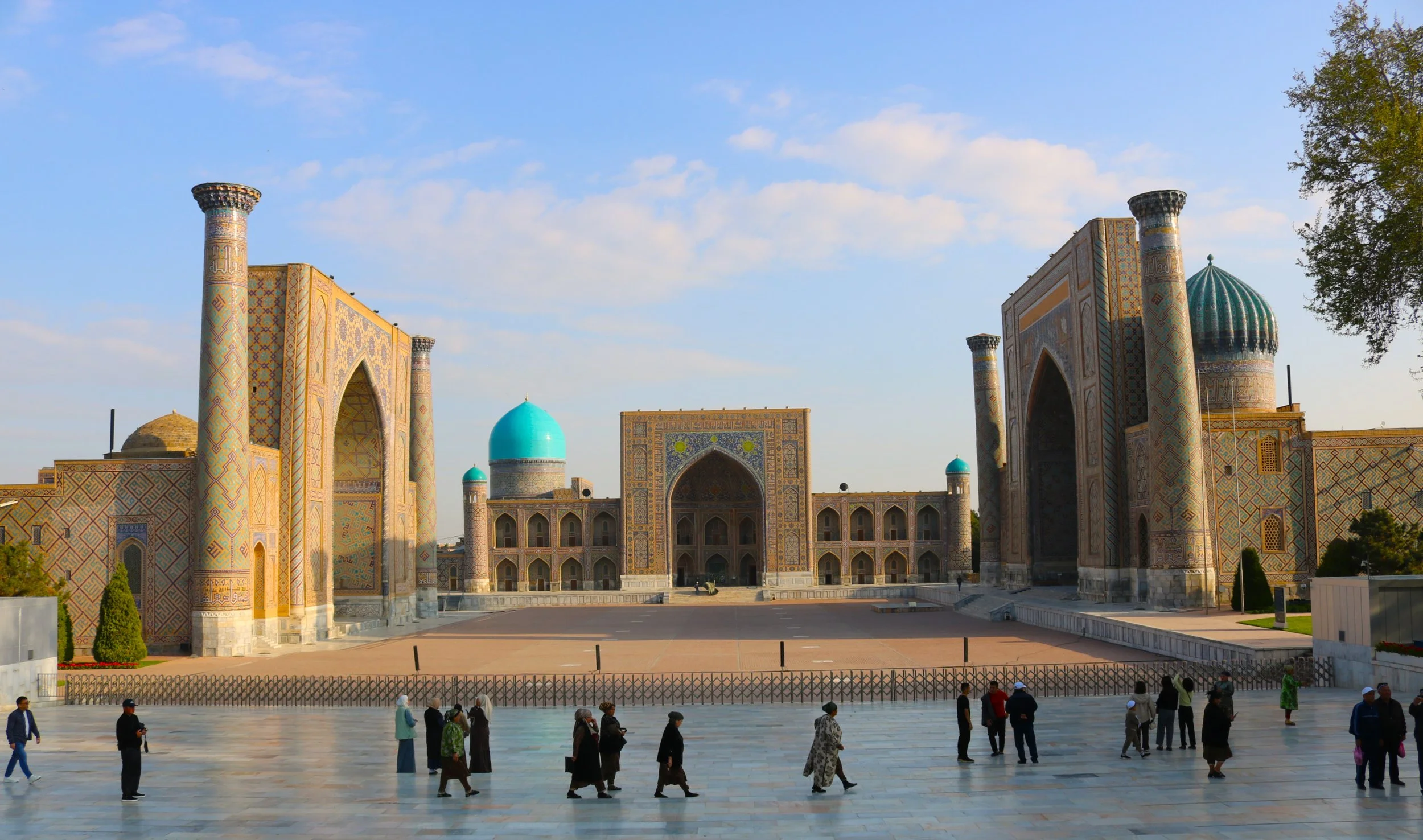
REGISTAN SQUARE IN SAMARKAND