GETTING ROPED IN ON SRI LANKA
Having explored the fusion of religion and culture in Nepal recently, we thought a trip to the other end of the Indian subcontinent might offer some interesting contrasts. Sri Lanka accommodates over 22 million people on an island slightly smaller than Ireland. Most of its people profess Buddhism as their religion, with Hindus providing a very significant minority. Broadly speaking, Northern Tamils are Hindu while the Singhalese southerners are Buddhist, although there is a growing number of Muslims and a diminishing band of committed Christians. Unlike Nepal, there is a history of recent serious sectarian violence related to religious affiliation, and this culminated in the murder of 261 folk by suicide bombers in the coordinated 2019 Easter Sunday massacre which had a hugely adverse effect on Sri Lanka’s economy. Compounded by Covid, agricultural reforms and recurrent floods, this precipitated their 2022 financial crisis.
Tourism dropped off a cliff for two years. However, the resilience and unfailing friendliness of its people have subsequently combined to catalyse a reversal of this trend. Visitors are returning from many points of the compass, and in greater numbers than before. Europeans account for much of the influx. We helped to pull in fishing nets at Tangalla* with Danes and Poles, took the local bus with a French couple, and shared beers on the beach with Swedes and Czechs. Even a group of Azerbaijanis exchanged experiences while sheltering with us from a thunderstorm under the walls of Galle Fort.
The Fort is the best preserved of all the monuments depicting the huge influence of European powers on the development of Sri Lanka. The colonial and trading aspirations of the Portuguese were displaced by the Dutch after half a century. Dutch construction of the Forts in both Colombo and Galle was dependent on African slaves (‘Keffirs’). In Colombo, they were imprisoned on ‘slave island’, created by a series of canals infested with crocodiles to keep them confined to quarters. The British were no better when they took over after Napoleon’s defeat at Waterloo. They massacred many locals, displacing them from their tribal heartlands. They planted coffee, then tea and rubber, exploiting the fertile soils and reliable rains. Despite the legacy of language, cricket, and railways* the Brits left, their record of exploitation of the peace-loving Buddhist people remains.
One of the most striking monuments of Buddhist devotion is at Dambulla, where the local King was forced to seek refuge from invaders in a remote hillside cave for 14 years in the first century BC. In gratitude at the return of his kingdom, he later devoted the caves to the worship of Buddha and his many supporters. The series of caves has a marvellously maintained collection of statues and frescoes*, guarded by a giant golden Buddha at the lion’s mouth entrance to the complex*. Nearby the ‘twin towers’ of rock rising naturally from the flat landscape magnetise visitors. Showy Sigiriya was adapted as a military base, while shy Pidurangula was occupied by Buddhist monks who still maintain their temple below a summit peak demanding determination and dexterity.
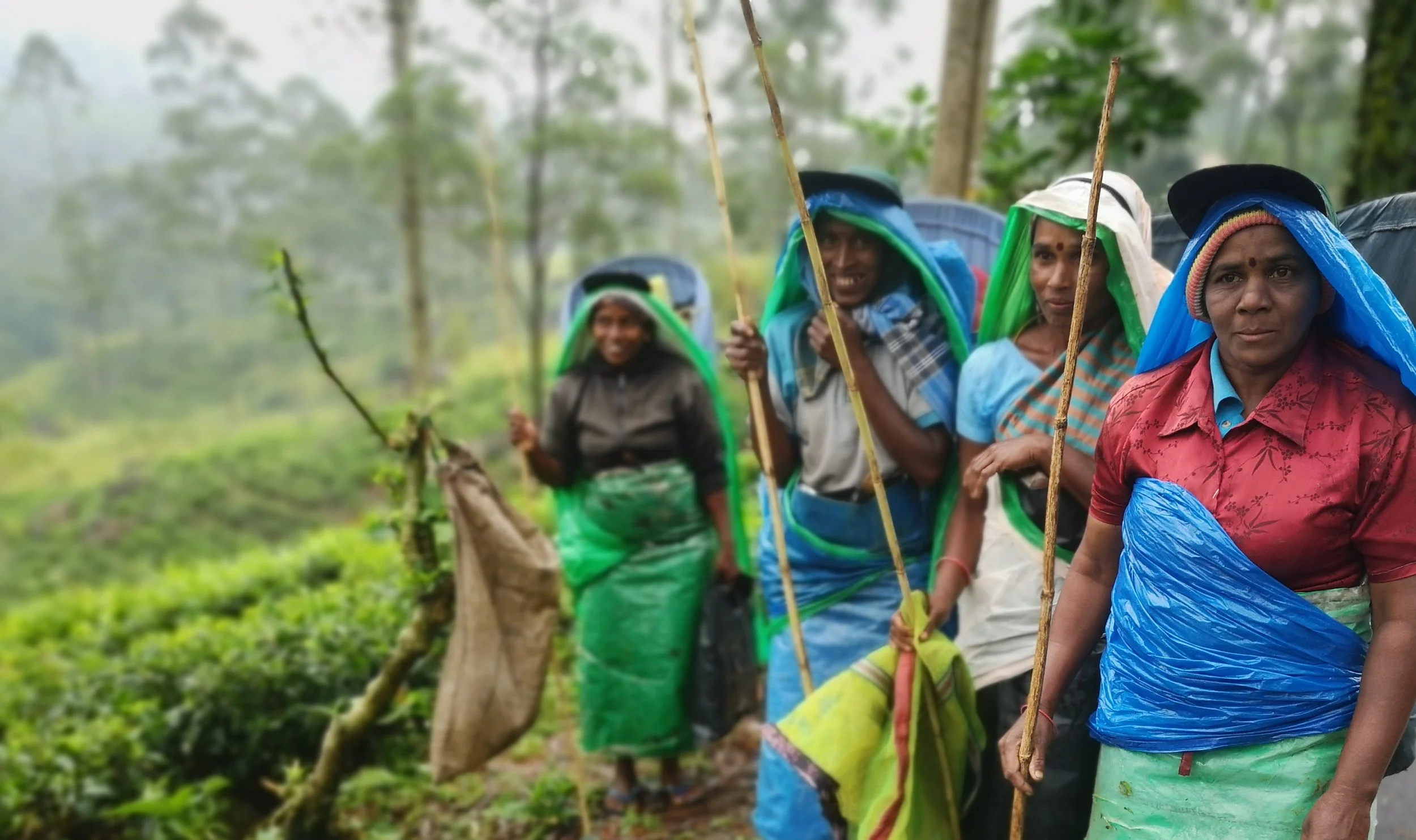
Further south, Kandy is best accessed by train, and houses a tooth reportedly rescued from Buddha’s ashes after his cremation. The golden temple constructed to honour this relic lies on the edge of a large lake monitored by real water dragons!* Local traditions abound, including impressive displays of fire-eating and acrobatics*. Heading higher into the hills, worship of a different degree becomes evident. Devotees of tea indulge their tastes in multiple varieties of leaves, hand-picked by a veritable army of trained workers*. Paid a daily rate of just 850 rupees (£2.50) for their labour, is it surprising that relations with their employers can become ‘strained’? Dominating the local landscape are a series of mountains including Adam’s Peak (Sri Pada). We struggled to the summit shrine* surrounding Buddha’s footprint in whistling wind and relentless rain. Pilgrimage felt like an appropriate apology, if not quite atonement for our predecessors’ incursions.
To the south along the coast, between Tangalla and Galle, lie a series of fishing villages* largely overtaken by tourism. Here beer and burgers have suppressed sales of fish curry and arrack, pandering to the tastes of a rapidly-growing Russian enclave. Seeking sanctuary from a conflict many of them wanted no part of, they dominate the beaches at villages like Unawatuna. Despite the rush of their rubles boosting the local economy, many Sri Lankans expressed their doubts to us about this latest influx of foreigners. Given their extensive adverse experiences of uninvited guests over the centuries, one can understand why. Between the mountains and the coast, other more gentle giants roam. We visited Udawalawe national park, where huge herds of elephant meander, sometimes exploring the tea plantations or even stopping local traffic until offered a banana. They seem unafraid of humans and are quite content to pose for portraits*. It was a privilege to see families roaming together and amusing to note that numerous peacocks* took advantage of the abundant free fertiliser to establish their own colonies under the trunks and tusks of the elephant hordes.
For a country with such a troubled political past, it was an unexpected pleasure to see a general acceptance of so many religions in such close proximity to each other. It was impossible to travel more than a mile without seeing a brightly decorated Shrine, Temple*, Mosque or Church, most of which were in active daily use. Sri Lankans were always interested in our views and experiences of their country, and keen to impress with their civic pride and prowess. Despite their recent economic challenges, they have developed and maintained an excellent universal health care system and offer high-quality free education from preschool to university degree level. Their society is open and accepting, adapting rapidly to overseas influence whilst maintaining their traditions and identity. Maybe the British could learn a lesson or two from their former colony?