By the time the Spanish Conquistadores made landfall in ‘Las Americas’ at the beginning of the 16th century, the imperial empire developed by the Mayans from 500BC was already in terminal decline. This stretched from Mexico down to modern day El Salvador and Honduras, but the greatest concentration of City States was in southern Mexico, Belize and Guatemala. What were the reasons for this decline and how did Spanish colonialism shape the Central America of today? The best way to investigate this conundrum was to experience and explore the people and their places first-hand.
Taking advantage of my employers’ insistence that I use my remaining allocation of annual leave, early January saw two new arrivals in the ancient town of Antigua. I’d persuaded Peter that some winter sunshine was just the tonic he needed, so we flew to the mountainous region of southern Guatemala, with return tickets from Mexico some three weeks later. Submerged by mountains, Antigua was established by the Spanish in 1543. But its location on the ‘ring of fire’ ensured that threats from earthquakes, floods and fire made it an ultimately unsuitable capital. Its rustic charm has survived natural disasters sufficiently to allow its recolonisation by modern tourists and travellers. Many rightly explore its heritage, but we also felt obliged to scale its encircling volcanoes.
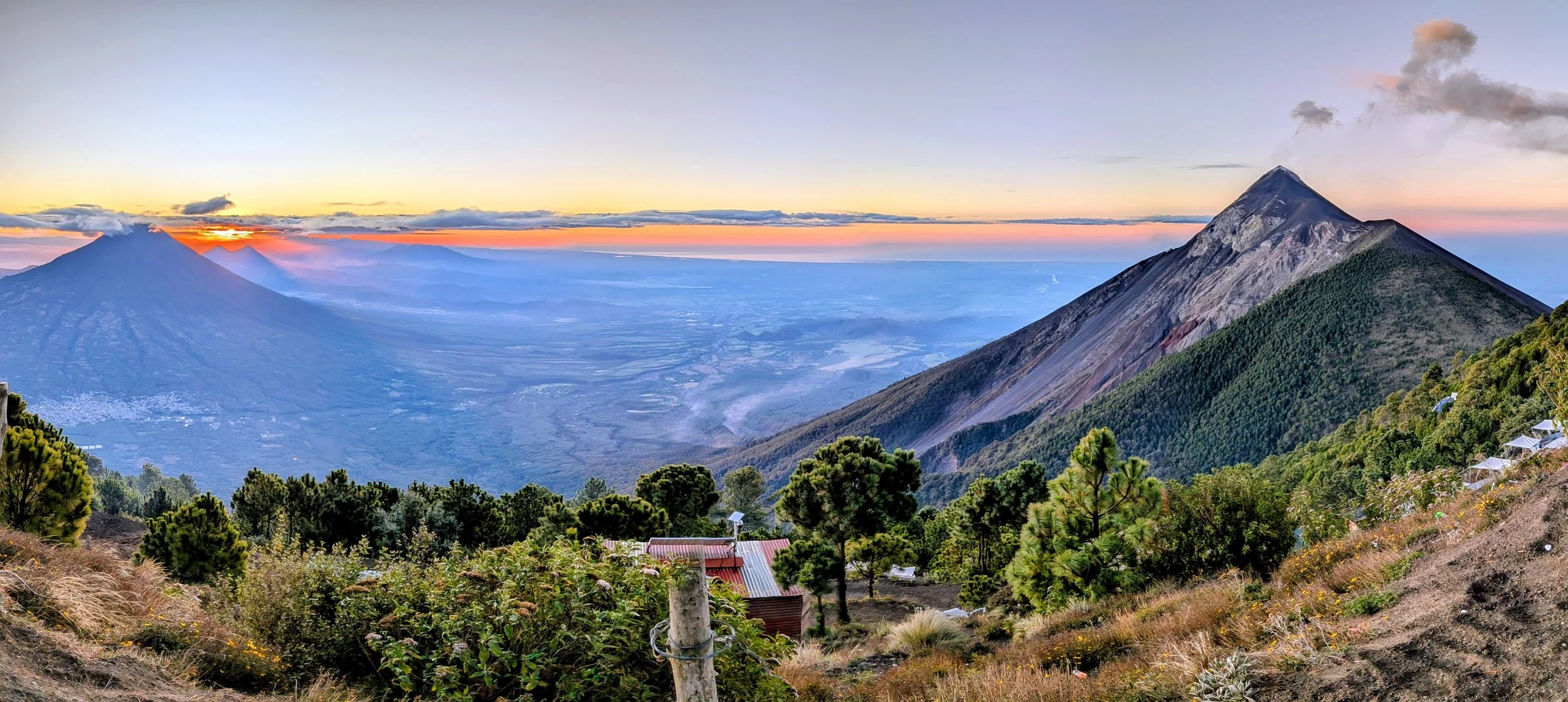
Rising over 13,000 feet above the Pacific Ocean, Acatenango dwarfs its neighbours, Fuego (‘Fire’) and Agua (‘Water’). The optimal vantage point (1) is from the much smaller volcano, Pacaya, which itself remains active enough to allow visitors to routinely roast marshmallows in its sulphurous rocky recesses. Having reconnoitred our route, we set off the next morning to explore Acatenango. Reaching base camp by late afternoon, we made it safely to the summit for sunset. Returning by torchlight, we found our camp illuminated every few minutes by Fuego’s constant eruptions just one kilometre distant. Such was the spectacle that sleep was impossible: it’s rare that you experience fire and brimstone spewing from the centre of the earth, chasing hot lava down the hillside (2).
Retreating to Antigua the following day gave us time to appreciate its colonial Churches (3) and the Cathedral of San Francisco El Grande, which contains a huge pilgrims sanctuary. Its cloistered gardens were dominated by a life-sized rendition of the stable at Bethlehem, where the recently arrived Balthazar appeared to be actively evicting a recalcitrant sheep to gain better access to the newborn Saviour! Forsaking camels, we took the bus to Lake Atitlan. Also surrounded by volcanoes, the lake offers sanctuary to tired tourists. La lancha is the boat service to the many villages dotting its shores, and we caught the last craft to San Juan, perched at the far end of the lake. Each village has a distinct character, as well as its own soccer team. Several of these were very successful until the mayor made the difficult decision to invest the Lake’s limited income in a secondary school instead, following the pandemic. We climbed through coffee and avocado plantations and pickers perched steeply on the hillside (4) as we sweated up another interminable slope. But we were surprised to find a Catholic service reaching a conclusion in an outdoor chapel just below the summit. Decked out with fresh flowers, its Mayan congregation had gone to some trouble to attend Mass (5). Curiously, having initially resisted the new-fangled religion of the conquering Spanish, the Mayans subsequently embraced Catholicism and are now its greatest devotees.
Dropping off the summit into the village of Santa Clara allowed us a large lunch at a local restaurant where a sign stated ‘No debes para manana lo que puedas comerte hoy’. Translated as ‘don’t save for tomorrow anything you can eat today’, we weren’t the only obedient ones (6). Semuc Champey lies a long bus ride north of the lake, in the midst of verdant jungle. Roughly translated to ‘where the river runs under the ground’, the limestone cliff has been eroded by an underground stream which can be followed deep into the hillside by those prepared for an adventure. Risk assessments are pretty superficial in rural Guatemala, and equipment is basic. A candle was the only tool provided for the hour it took us to wade through the caves, behind waterfalls, scramble up cliffs and exit via an underwater slide (7)! We celebrated our survival by tubing down the river once it regained the valley, before luxuriating in the warm shallows below (8).
Now we were in the heart of the Mayan civilisation. Tikal lay in the swampy jungle north of the great lake of Peten Itza. Here they constructed magnificent pyramids in honour of their leaders (9). Subsequently reclaimed by the jungle, the complex was rediscovered relatively recently and is still being explored. The sight of ancient temples rising from misty swamps at dawn to the roars of howler monkeys will linger long in the memory. We watched modern-day Mayans in traditional clothes performing their religious rituals around a fire lit in the centre of the temple complex (10). We returned to the lake where the gaily painted tourist town of Flores is centred on its island (11). Peten Itza was the last area to fall to the Spanish after fierce fighting. Disadvantaged by the lack of metal, they fought with wooden swords tipped with flint. They had neither wheels nor beasts of burden to call upon, but the weapon the Spanish wielded most effectively was not their superior firepower, but their stronger immune systems. The Mayans had no resistance to the viruses that accompanied the invaders, and they died in droves from influenza.
But in truth the seeds of destruction had been sown centuries earlier. The Mayans had prized astronomy above other sciences and built their temples to reflect the passage of both Earth and Venus. They understood intimate aspects of astrology and medicine, so astronomers and physicians were at the top of the social pyramid. Just below them sat the traders who brought tools, clothes and food from friendly cities throughout the kingdom. But they were warlike too and feuds abounded, with rivalry resulting in bloody conflict. They were also environmentally short-sighted: they relied on local rivers and cenotes for water, and on the jungle for food and fuel. Climate change around 900AD led to the rains failing, and famine resulted. When their King was unable to alter the weather, Chaak, the Water God, was invoked with sacrifices of increasing intensity.
We visited Actun Tunichil Muknal (cave of the crystal sepulchre) just over the Belizean border. After two hours of navigating its dark serpentine tunnels, we emerged into the cavern where the Mayans paid homage to Chaak. Initially, they cut off the ends of their fingers. Then they pierced their tongues, collecting the blood in bowls and burning it. When drought intensified, they started sacrificing their children, culminating in the ritual offering of the heir to the throne. The Mayans abandoned their city thereafter and returned to the lake. We counted 19 skeletons in the sacrificial chamber. With huge irony, the rains returned and the resulting river flowed through the cave coating their bones with calcite crystals, embedding them into the floor for over a thousand years. We mused whether the same combination of climate change, conflict, environmental loss and false ideology may lead to the downfall of modern ‘civilisation’ further north?
Belize is very different to its Spanish-speaking neighbours. People are dark-skinned and speak creole. The climate is warmer with attitudes and atmosphere more Caribbean in flavour, as is the food and music. Faster buses on better roads sped us to Belize City, where we boarded a boat to Caye Caulker. This little island lies on the Belizean Barrier Reef, the world’s second longest collection of coral. But unlike its Australian cousin, much of the reef has survived the twin threats of warmer waters and terrible tourism. We spent time exploring the reef, watching manatees grazing seagrass, swimming with a school of nurse sharks, and envying the lazy underwater flight of giant stingrays (12). Around the world oceans are warming faster than coral can adapt. But the blanching of the Belizean reef was less evident than any other I’ve seen in the last decade, and the range and numbers of creatures inhabiting it pay tribute to the success of the protective measures put in place to prevent environmental pollution and inadvertent damage (13).
Caye Caulker consists of small islands linked by a rather unique ferry. No cars are allowed and the main strip is festooned with sunbathers and backpackers, invariably accompanied by marleyesque music. We made good our escape on one of the thrice weekly ferries departing for the Mexican port of Chetumal, from whence a short bus ride deposited us in the fortified town of Bacalar. Beautifully sited overlooking ‘la laguna del siete colores’, the Spanish protected its gold, rum and sugar supplies from English pirates with the fort of San Felipe, whose remaining canon catches the sunrise (13). The seven colours refer to the sparkling emeralds and aquamarines of the warm clear waters which nurture a very old and special lifeform (14). ‘Los estromatolitos’ are ancient cyanobacter which were the first organisms to produce oxygen from carbon dioxide. They evolved the ability to cement grains of sand which over many centuries led to towers of living rock accumulating just beneath the surface. The submarine cenotes facilitate this process by bringing up clear clean water from the hidden depths, providing the essential nutrients to facilitate the bacteria in their slow construction.
The Mayans believed in a complex transition from the underworld rising in multiple stages through the earth and into the heavens. This concept is symbolised in the tree of life. Fittingly, our Bacalar hostel was called ‘El arbor de la vida’, with the tree depicted as rising through the building. The roots are represented by the cenotes, limestone caves and caverns containing not just real tree roots but often also stalagmites and stalactites rising and falling through the waters to form stone pillars. In addition to providing an essential supply of fresh water, cenotes also offered a connection to the ancestors, with the stone pillars and tree roots inviting them to climb back up to earth once they had fulfilled certain tasks. For those who succeeded in life, the ascent up to the limbs and tree branches offered access to the heavens, from whence it was believed that the mountains (which were the seat of the Gods) could be surmounted, with the volcanoes named after the essential elements of Fire (Fuego) and Water (Agua).
We had initially planned to follow the Mexican coast up to Cancun but changed our minds on learning of the adverse impact western tourism has had on this area. The coast all the way down to Tulum has become polluted by the construction of hotels on a massive scale, altering the biosphere and damaging the associated reef. Instead, we headed inland on the Yucatan peninsula bypassing Tulum and Cancun, and spent our last few days based in Valladolid. This splendid small city proved to be the perfect base. Built on the site of a previous Mayan settlement, it contains the well-preserved San Bernadino monastery. Built by the Spanish five centuries ago (15), it has a chequered history as it was used as a refuge by opposing factions in the Mexican civil and slave wars. The monks granted amnesty to everyone who surrendered their weapons, which were ceremonially thrown down the cenote in the monasterial gardens (which provided their fresh water!). Recently, this has been dredged, and the retrieved flintlocks, swords and muskets are exhibited in the monastery’s small museum. The complex contains beautiful examples of the refectory, stables, chapels and the cloistered walks which are so typical of Spanish religious colonial architecture (16).
From its colourful square, San Bernadino is connected by ‘el diagonal’ which runs a kilometre up to the town centre. Just one block from the Cathedral is Cenote ‘Zaci’ which is used as a local swimming pool. Like most cenotes the deep water is full of black catfish, no doubt bemused at the antics of visitors who jump in from a range of rocky platforms of increasing altitude (17). Hiring bikes for a day, we explored the villages and cenotes in the surrounding areas. Some cenotes are easily accessible, with collapsed roofs forming a bowl-shaped swimming pit. Others are hidden deep underground, found only with careful navigation and accessed down long flights of steep steps cut into soft limestone. These cenotes have roofs, often with a small central opening through which daylight filters, illuminating the clear green waters below (18).
Our final adventure was another early start to explore the fabled city of Chichén Itzá. Translated as ‘the mouth of the magic waters’, this huge complex was built on underground streams which fed into several cenotes. One of these was considered sacred, and according to custom, individuals thrown into the Cenote Sagrado were believed to have the power of prophecy if they survived. During one such ceremony, there were no survivors, so a man leaped into the cenote, and when rescued, correctly prophesied his own kingship. The dominant building is the temple of Kukulcán, who was a serpent deity. Every equinox, the corner of the pyramid casts a series of shadows evoking the appearance of this snake wriggling down the staircase (19). Great import was also given by the Mayans to a ballgame which involved trying to bounce a 4kg stuffed leather ball in the opposition’s court. Over time this game became a proxy for resolving conflict, with rival cities sending a team of players instead of soldiers. Nonetheless, they did play to the death quite literally as the victorious captain publicly decapitated his opposite number! Nowadays the site is visited by huge numbers of tourists flooding in from the coast around Cancun. It is highly advisable to arrive before them to appreciate the amazing views of the temple, ballcourt and the incredible planetarium (20). For those keen to know more about the Mayans, this link is really interesting: https://www.theguardian.com/news/2026/feb/12/apocalypse-no-how-almost-everything-we-thought-we-knew-about-the-maya-is-wrong?CMP=share_btn_url
Despite their past reputation, the people of central America are incredibly friendly and very honest. It was such an exciting trip that we plan to return next January and travel south from Guatemala through El Salvador, Honduras, Nicaragua and Costa Rica.