THE HIGHS AND LOWS OF GEORGIA
Perhaps the confusion over the Country versus the State adds to the mystery which surrounds this historic mountainous land, itself encircled by countries which have slowly shaped its destiny over centuries. Successive invasions from the Persians, Mongols and the Ottomans left their mark on the people and their culinary habits, while the Russian occupation from 1921 to 1990 remains a recent and very real memory. Indeed, part of Georgia remains under Russian control even today. Yet despite its turbulent past and present politics, its people remain fiercely independent and very proud of their identity. Although their population is just under 4 million, they regularly punch above their weight on the sporting stage in wrestling and rugby. Despite the fact it's geographically in Asia, Georgians are looking increasingly to Europe for their identity.
Georgia’s flag of five St George’s Crosses offers a clue as to its Patron Saint, shared with England. However, alternative explanations for the country’s name come from the days of Alexander the Great, who named it ‘Gurjan’ after the wolves who roamed freely around the forests and mountains, and from the Greeks who named it ‘Georgos’ after the farmers who inhabited the pasturelands. Their religion is predominantly Orthodox Christian and is one of the oldest Christian Churches, tracing its origins to St Andrew almost two thousand years ago. Monasteries are abundant, even in the most remote parts of the country, and are beautifully maintained and well-visited. A consistent feature was the number of young people who venerated the icons in the Churches and who sought instruction and advice from the black-robed and bearded monks presiding over them. This conveyed to us a strong sense of both respect and commitment.
The capital city, Tbilisi, situated on the river Kura, is the main point of entry for westerners and accommodates 40% of the country’s population in its leafy suburbs clustered around a large lake. The old town has been extensively and lovingly restored, with the Narikala fortress and the Meidan Bazaar both reminders of its heyday when it serviced the caravanserai which traversed the Silk Route from Constantinople to China. More recent developments are evident in the rest of the sprawling city, serviced by a noisy but reliable underground system built by the Russians in 1966. We headed out one Friday night into the suburbs for a musical event and noticed that some of the older tower blocks were decidedly unstable. Tbilisi’s strong economic performance and high levels of educational attainment suggest that safer accommodation will soon be built.
After our initial orientation we set off northwards to the Caucasus. The military road leading to the mountains also transports many goods to Russia and we saw queues of lorries stretching back 30 km as we approached the border. En route we visited the ancient fortress church at Ananuri*, overlooking the lake at the foot of the mountains. Climbing the worn stone steps led onto a rickety roof with loose slabs, and a strong sense that no risk assessment had been performed. The icons in the church were of burnished silver. We lit candles and added our silent prayers for safety in the heights!
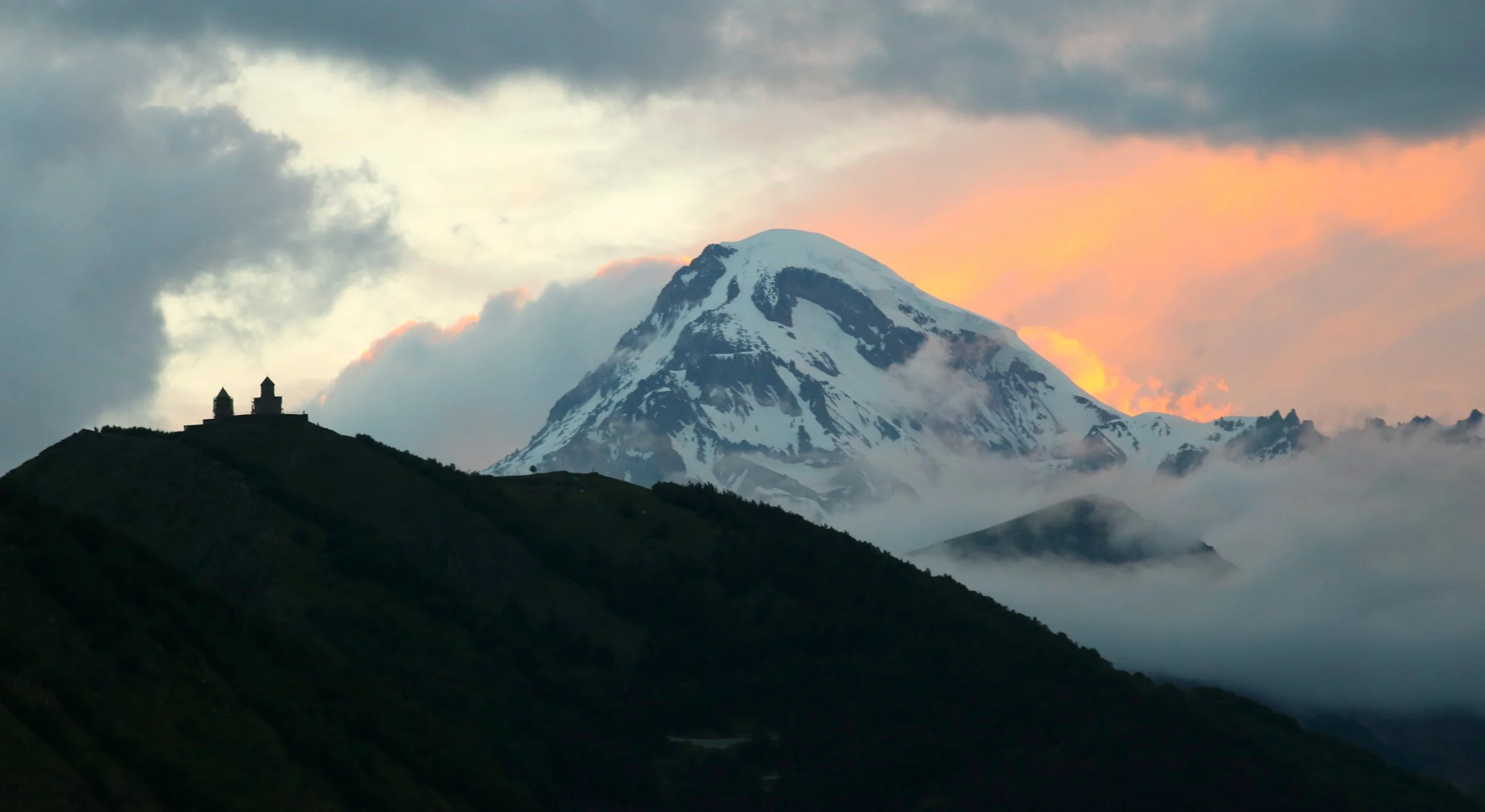
Further into the Caucasus, at a height of 2,300m, we inspected the Friendship Monument. Although this celebrates the links between Georgia and Russia, the ground beneath it drops into the Devil’s Valley*. Just saying! Shortly after, the road dropped towards the Trusso, and then the Juta, valleys, before depositing us in Stepantsminda, a rapidly expanding tourist village submerged by mountains. Mount Kazbeg (5,054m) dominates the view, but the valley is complemented on the other side by Angel Peak and the Chaukhi massif. We stayed in the upper part of the village with splendid views across to Kazbeg and the village of Gergheti, whose church is perched on the top of a cliff accessed by a winding footpath through fields festooned with wildflowers*. It being Sunday, we left our rucksacks at our lodge and hiked the hill to the perfectly located church towering some 500m above us.
Again, it was buzzing inside and out, with dignified worshippers who donned modest clothing before lighting their candles and kissing the ikons with a quiet prayer*. People congregated at this beautiful spot from all over the world. We descended slowly marvelling at the views and watched the clouds lift off Mt Kazbek as the sun set* while we dallied over dinner. Much Georgian food is unique, with dishes such as khinkali (the mushroom variety were the best) and khachapuri (a canoe-shaped bread boat filled with egg and cream cheese) among the most memorable. Walnuts and coriander feature freely, washed down with the wine the Georgians claim to have invented (others may dispute this!). An early night presaged a challenging day to come.
Climbing back up to Gergheti church was the least of our challenges, as we then struggled up the ever-steepening lower slopes of Mt Kazbek as far as the col. When the sun finally broke through the scene was transformed. We could see the route over the glacier between the mountain huts and followed it to the base of the retreating icefield*. Having ascended 5,000 feet by evening, we beat a reluctant retreat down to our hotel. We noted a bright yellow sign on the mountain warning us not to transgress over the border with Russia with a strong hint of serious reprisals for those who descended on the wrong side of the mountain. The alphabet and language of Georgia is pretty unique. It emanates from a now extinct language with no proven links to any other. It evolved after the fifth century when Georgians occupied the now Turkish area of Anatolia.
A trip to the Dariali waterfalls and Monastery situated on the Russian border offered a less onerous option the next day. The Monastery is new but built in the traditional Georgian style*. I don’t think I’ve ever been to a Christian country with so many monastic buildings and monks dwelling therein! A longer walk up into the remote Trusso valley was next on our agenda, and we were fascinated by the multi-coloured mineral pools and streams* which contrasted with the raw beauty of the snow-capped mountains. Our walk encompassed a challenging river crossing to visit the almost abandoned village of Ketrisi*, situated under a ruined fortress which once defended the valley from northerly incursion. Sensibly, our new-found friends (A Czech mother and daughter) declined to follow us across the raging torrent. However, this was one of those days when the sheer beauty of nature tempted one to linger longer than was wise. Reluctantly returning to civilisation we were too late for any form of public transport and were deeply indebted to a local lad who conveniently dropped us off at a restaurant.
Halfway through our meal we were joined by two Kiwi guys in their twenties who had cycled all the way from Istanbul and planned to carry their bikes over the Chaukhi massif at the end of the Juta valley the next day. Just listening to their exploits made us feel lazy. They worked in bridge construction back in New Zealand and had saved enough for a long trip. However, their budget was lasting longer than expected as everywhere across Turkey, the locals had given them free food and accommodation! Meeting others is part of the joy of travel, and we had plenty of interesting encounters. Staying at the same hotel were an Indian couple in their late 30’s. True digital nomads, they worked on their IT business online for a few hours every couple of days while travelling the world. They talked about possibly settling down in Vietnam one day!
The next morning, we took a local taxi to the ancient village of Sno in the Juta valley. Before commencing our ascent of Angel Peak, we bought bread and cakes sufficient for three lunches for the princely sum of 5 Georgian Lari (£1.40). Although tourist transport can be moderately expensive, food and accommodation remain extremely affordable. We meandered up a southerly ridge of this 10,000-foot mountain, stopping frequently to admire and record the huge range of wildflowers. We counted over 20 different varieties, some of which I’d never previously seen. We followed a rough track made by wild horses and after what seemed like an eternity, finally cresting the summit to be rewarded by the sight of our village in miniature on the valley floor below*. We foolishly discarded the option of returning the same way in favour of a more direct descent. We nearly didn’t live long enough to regret it, as our route led us down an increasingly precipitous ravine that terminated in a waterfall. Retracing our steps, we had to fight our way through dense forest where we were attacked relentlessly by some of the largest and fiercest mosquitos I’ve ever encountered. Peter’s persistence was eventually rewarded, and we eventually dropped down through a rhododendron wood into our valley, parched and scratched to pieces. But better than adding to the Angels already on the mountain!
On our last morning in the mountains, we hiked up to the picturesquely situated Elia Monastery on the other side of the valley to Mt Kazbegi but affording an excellent view*. A monk appeared every hour to painstakingly ring the Monastery’s big bell and the sound reverberated around the valley. Having opinionated in a previous article that Buddhists build their temples on the tops of mountains while Christians prefer the valleys, I must admit that Georgia is definitely an exception. Our driver on the way back to Tbilisi told us his wife was studying for her PhD in the USA and that they planned to resettle in Germany when she finished. This was a recurring theme I’ve encountered recently in many eastern European states: that whilst educational attainment is often good up to undergraduate level, many more capable citizens are moving to Germany, Italy or France to continue their postgraduate careers. Many of the new generation have academic ambitions but for a significant number this appears to involve leaving home.
We had a final day to explore Tbilisi further. The Holy Trinity Cathedral is stupendous*, and the approach to the gold-topped spire is vaguely reminiscent of the Taj Mahal. While Mike and Peter then toured the art galleries, I explored the Botanical gardens which occupy a large tract of land behind the fortress. Reconvening in the early evening, a trip to the hot Sulphur Baths was the perfect way to conclude our journey: legend says that Tbilisi was founded when a pheasant shot by the king was boiled in the hot spring waters by the time the monarch retrieved it. He was impressed by the thermal option and so were we. We felt we’d paid due homage to both high and holy places during our trip to Georgia, again combining climbing with gaining insight into this fascinating place.